Skip to content 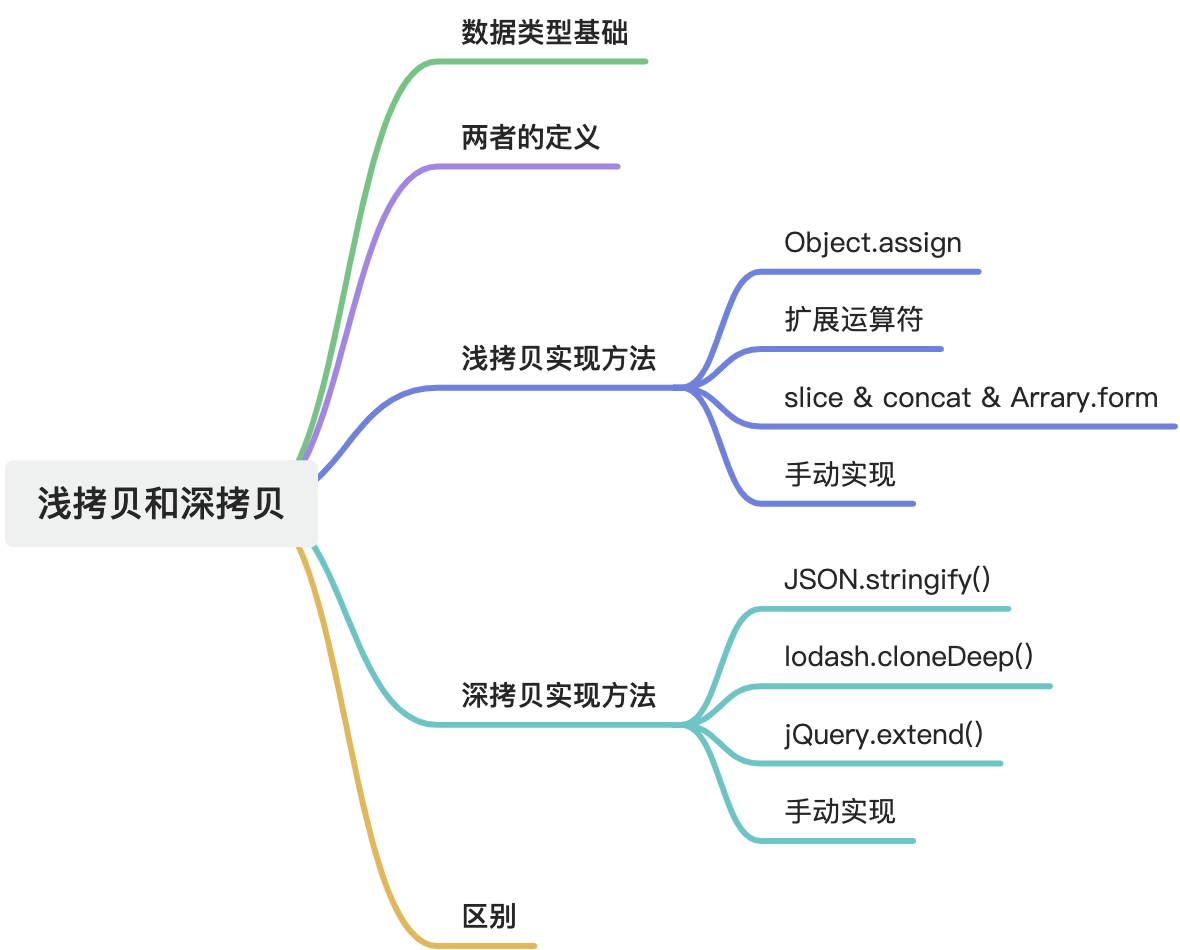
Shallow Copy and Deep Copy
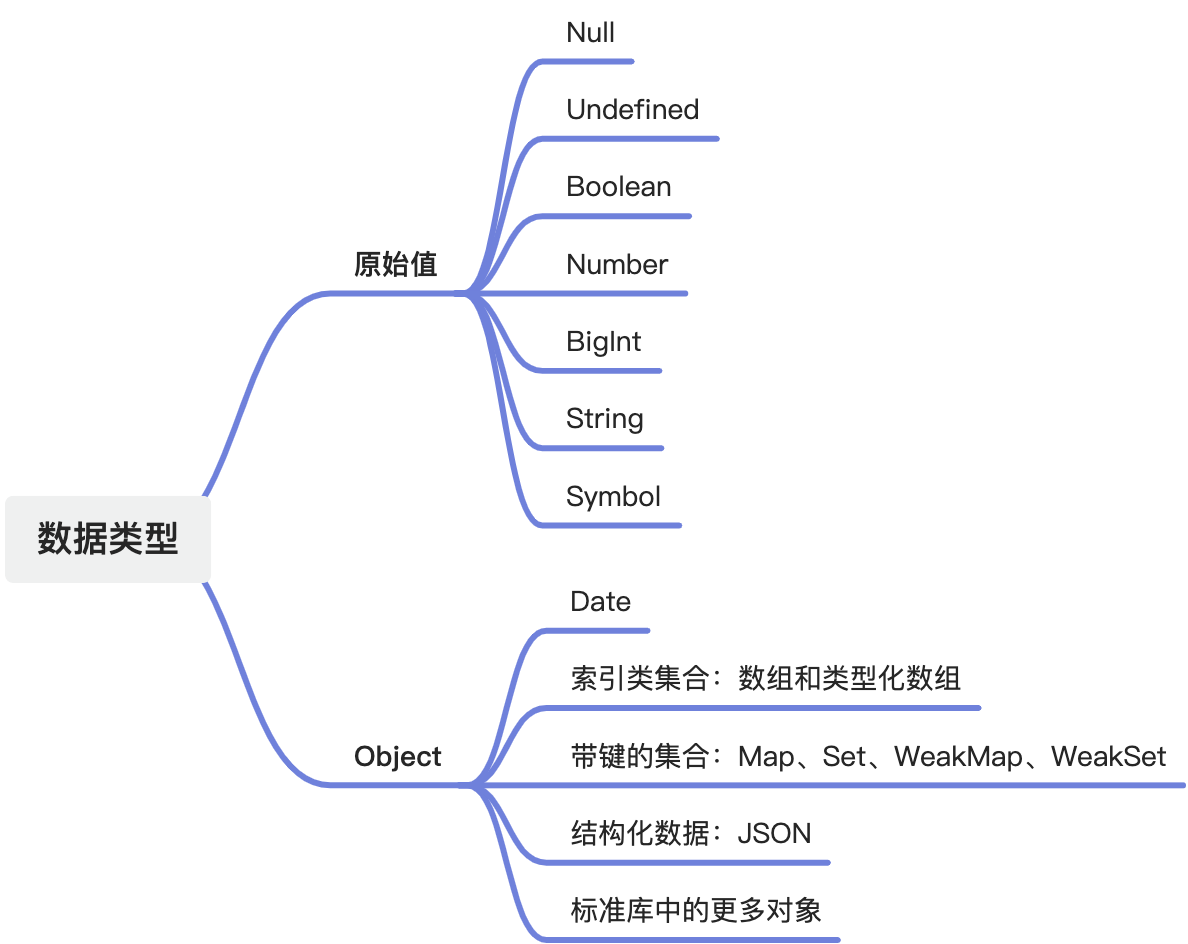
To explain shallow copy and deep copy clearly, it helps to first understand JavaScript data types.
Data type basics
Except for Object, all types define immutable values at the lowest level of the language. We call these values primitive values.
In computer science, an object is a region of memory that can be referenced by an identifier. In JavaScript, objects are the main mutable values. In fact, functions are also objects, just with callable behavior.
Primitive values are typically discussed as being stored directly, while reference-type data such as objects is stored by reference. A variable holds either a direct primitive value or a reference to a location where the object data lives. Once that distinction is clear, the difference between shallow copy and deep copy becomes much easier to understand.
When we talk about shallow and deep copy, we are mainly talking about objects. Primitive values are simply copied as values, so the deep-vs-shallow distinction is not especially meaningful for them.
Definitions
Shallow copy
A shallow copy of an object copies the object's top-level properties, but if a property points to another object, the copy and the original still share the same reference.
That means:
- top-level primitive fields are copied by value
- nested objects are still shared
- changing a nested object through one reference can affect the other
The core behavior is that only one layer is copied. If a property is a primitive, the copied value is independent. If a property is a reference type, the copied result still points to the same underlying object.
Important: changing a nested property's contents is very different from assigning an entirely new value to that property. That distinction matters a lot when thinking about shallow copies.
Deep copy
A deep copy creates a completely independent copy of the source object's nested structure.
That means:
- nested objects are copied recursively
- the new object does not share nested references with the original
- changes on one side do not affect the other
In short, deep copy clones the object together with the objects it refers to.
Ways to create a shallow copy
Object.assign
Usage
javascript
const objClone = Object.assign(target, ...sources);Notes
- It does not copy inherited properties
- It does not copy non-enumerable properties
- It can copy
Symbolproperties - Later properties overwrite earlier ones when names collide
Spread syntax
Usage
javascript
// object
const objClone = { ...obj };

// array
const arrClone = [...arr];
Notes
Its limitations are similar to Object.assign(), but it is often more convenient when the data is mostly primitive fields.
slice, concat, and Array.from
Usage
javascript
// slice
const arrCloneBySlice = arr.slice();

// concat
const arrCloneByConcat = [].concat(arr);

// Array.from
const arrCloneByArrayFrom = Array.from(arr);
Manual implementation
javascript
function clone(target) {
  if (typeof target === "object" && target !== null) {
    const cloneTarget = Array.isArray(target) ? [] : {};
    for (let prop in target) {
      cloneTarget[prop] = target[prop];
    }
    return cloneTarget;
  } else {
    return target;
  }
}
Ways to create a deep copy
JSON.stringify()
javascript
function deepClone(target) {
  if (typeof target === "object" && target !== null) {
    return JSON.parse(JSON.stringify(target));
  } else {
    return target;
  }
}
This is the simplest and most direct approach. It works for some basic cases, but it has many limitations. If your data is simple and you understand the trade-offs, it may be enough.
lodash.cloneDeep() and jQuery.extend()
These are representative utility-library solutions and are straightforward to use.
javascript
// lodash.cloneDeep()
_.cloneDeep(value);

// jQuery.extend()
jQuery.extend(true, {}, value);
Manual implementation
Before implementing your own deep clone, ask what it needs to support:
- Can it clone primitive values correctly?
- Can it clone plain objects whose keys and values are primitives?
- Can it clone
Symbolkeys? - Can it clone
Date,RegExp,Function,Map, andSet? - Can it clone function objects?
- Can it preserve prototypes?
- Can it clone non-enumerable properties?
- Can it handle circular references?
You can improve the implementation step by step.
First version
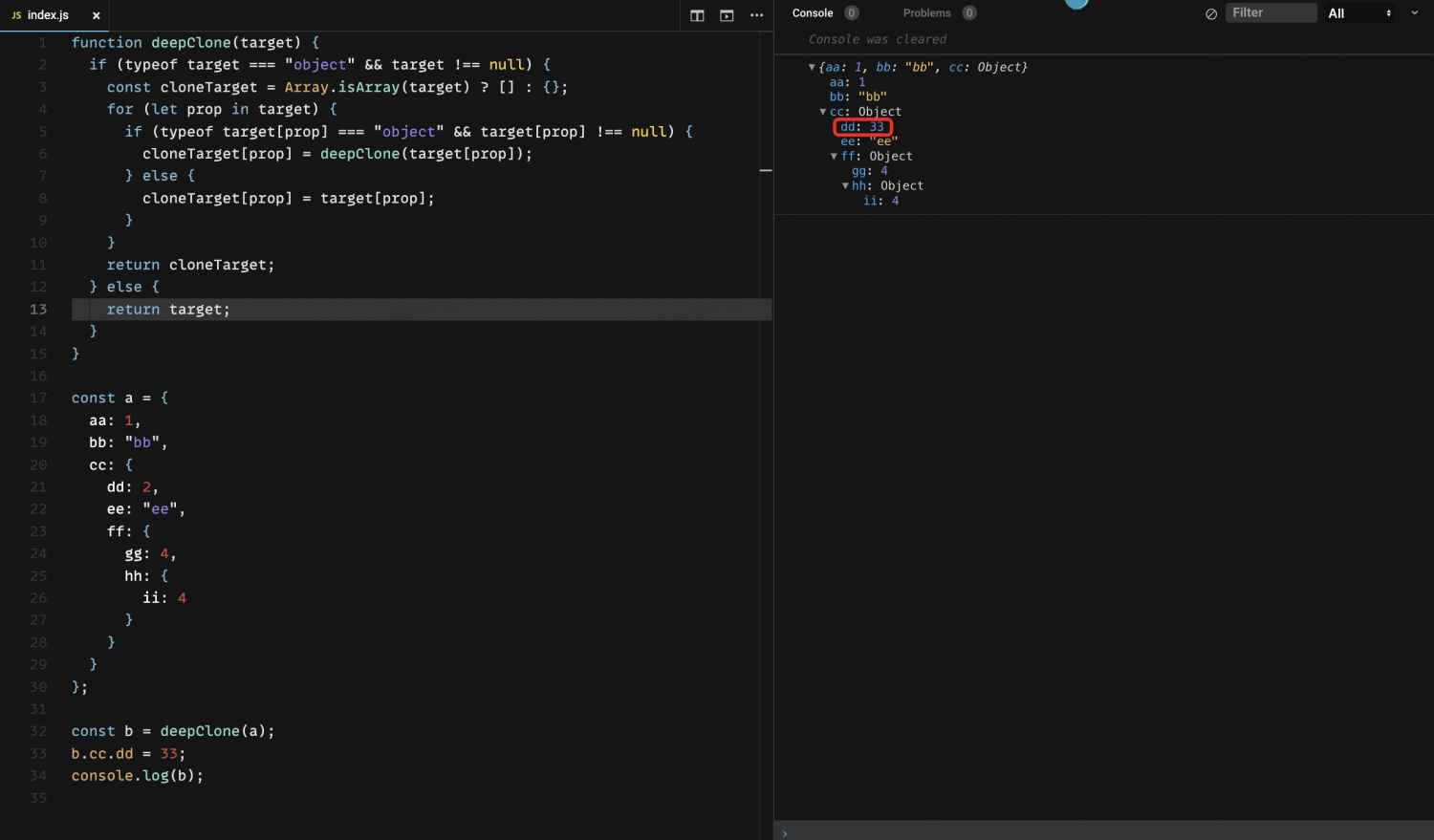
Turn the earlier shallow copy into a recursive version so it can copy deeper levels:
javascript
function deepClone(target) {
  if (typeof target === "object" && target !== null) {
    const cloneTarget = Array.isArray(target) ? [] : {};
    for (let prop in target) {
      if (typeof target[prop] === "object" && target[prop] !== null) {
        cloneTarget[prop] = deepClone(target[prop]);
      } else {
        cloneTarget[prop] = target[prop];
      }
    }
  } else {
    return target;
  }
}
This first version only really satisfies the first two conditions. To support the rest, the function needs to become more complete:
javascript
function deepClone(target) {
  const map = new WeakMap();

  function isObject(data) {
    return (typeof data === "object" && data) || typeof data === "function";
  }

  function clone(data) {
    if (!isObject(data)) {
      return data;
    }

    if ([Date, RegExp].includes(data.constructor)) {
      return new data.constructor(data);
    }

    if (typeof data === "function") {
      return new Function("return " + data.toString())();
    }

    const exist = map.get(data);
    if (exist) {
      return exist;
    }

    if (data instanceof Map) {
      const result = new Map();
      map.set(data, result);
      data.forEach((val, key) => {
        if (isObject(val)) {
          result.set(key, clone(val));
        } else {
          result.set(key, val);
        }
      });
      return result;
    }

    if (data instanceof Set) {
      const result = new Set();
      map.set(data, result);
      data.forEach((val) => {
        if (isObject(val)) {
          result.add(clone(val));
        } else {
          result.add(val);
        }
      });
      return result;
    }

    const keys = Reflect.ownKeys(data);
    const allDesc = Object.getOwnPropertyDescriptors(data);
    const result = Object.create(Object.getPrototypeOf(data), allDesc);
    map.set(data, result);
    keys.forEach((key) => {
      result[key] = isObject(data[key]) ? clone(data[key]) : data[key];
    });
    return result;
  }

  return clone(target);
}
This version handles a much wider set of cases:
- circular references through
WeakMap DateandRegExpMapandSet- symbol keys and non-enumerable properties
- prototype preservation
Summary
Shallow copy and deep copy are fundamentally about whether nested references are shared.
- Shallow copy only copies the first layer and keeps nested references shared.
- Deep copy recursively duplicates nested structures so the new object is independent.
In simple cases, spread syntax or Object.assign() is usually enough for shallow copy. For deep copy, JSON.parse(JSON.stringify(...)) is only safe for limited data shapes. In real projects, structuredClone, lodash.cloneDeep, or a carefully designed custom solution is usually the better choice when the data structure is more complex.